





Published on November 18, 2026
The better frontier AI gets, the more a trusted system of record is worth

The short version
- Claude for Manufacturing is a plugin with 17 skills and 4 connectors. It drafts quotes, NCRs, 8Ds and production reports for a person to approve.
- It runs on your systems of record, according to Anthropic.
- Poka is the frontline system of record and system of action, open to Claude and any AI tool through MCP.
On November 12, Anthropic launched Claude for Manufacturing.
This announcement validates what we experience every day: Manufacturers are digitizing their operations at an unprecedented pace. A frontier AI leader building for plants confirms what our category has argued for years: the knowledge inside a plant is the asset.
That knowledge lives with operators, mechanics, and engineers. It becomes an asset once it’s captured at the point of work and put back into action on the frontline. Connected worker platforms have done that for over a decade, and the platforms get better by the day through their own implementation of AI.
Anthropic acknowledges this. Claude starts from the records that plants already have, and a person approves every draft. So the key is understanding what Claude needs from your plant, and how it can strengthen solutions you already rely on.
Four questions follow, and they apply to Copilot and other enterprise AI as well.
1. What does Claude for Manufacturing actually do?
Claude for Manufacturing drafts quotes, NCRs, 8Ds, breakdown diagnoses, and production reports from a plant’s own records, for a person to approve.
It ships 17 skills and connects to Autodesk Fusion, Infor, Microsoft 365 and Oracle NetSuite on Team and Enterprise plans. Estimators, quality engineers, technicians, supervisors and buyers each get a first draft.
It “doesn’t run production control, operate equipment, or write to your systems of record.” In Anthropic’s words: “Vendors’ systems remain the system of record.”
That’s where Poka brings in the value. It holds the record for the shop floor. Claude works on top.
2. What does Claude for Manufacturing run on?
Claude for Manufacturing runs on your plant’s systems of record, most of them written on the floor. Estimators and engineers read records. Operators and technicians write them, one closeout at a time.
Anthropic cites a 2025 Manufacturing Leadership Council survey where 79% of manufacturers include manually entered data. Claude’s ability to give a helpful assessment is directly tied to the level of detail included in each closeout.
Ivan Getov, a maintenance manager who writes The Floor Report, tested three skills the day after launch. He started with diagnosing a breakdown: “The breakdown skill is a very fast reader. It can only rank what your techs wrote down.” A closeout that says “Greased. ok.” gives Claude little to work with.
But if an operator specifies that the machine was greased with a specific amount of lubricant, and that the machine began operating at the expected rates again, then that is more useful to Claude.
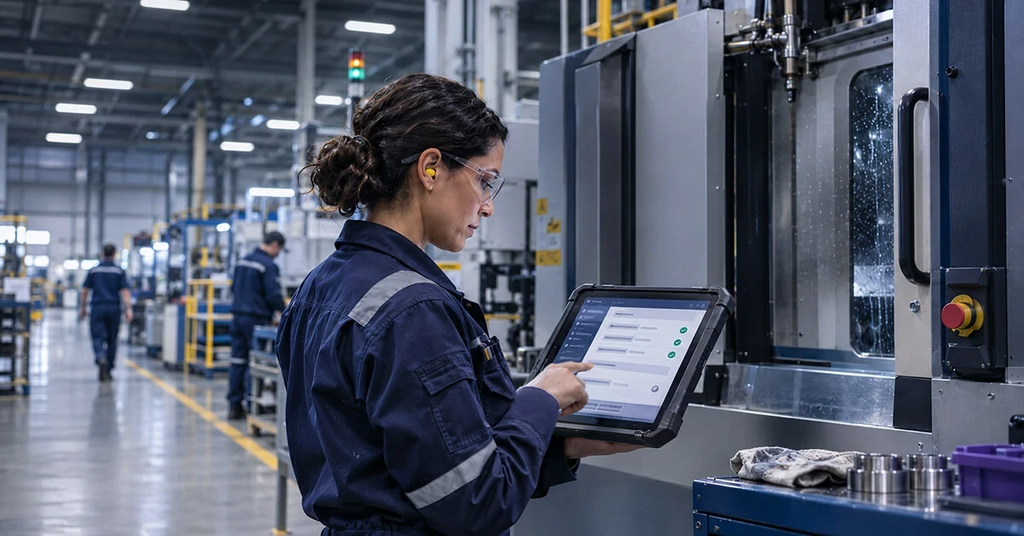
Most frontline workers won’t get an AI seat. They reach AI through the platform they use on the floor. That’s where your teams create the records Claude depends on. Poka also shares those records across sites: a fix proven in Lyon becomes the suggested procedure in Monterrey.
3. Can your enterprise AI tool reach your frontline data?
Your AI tool reaches frontline data (stored in a connected worker platform, like Poka) directly when you connect it directly over MCP. Otherwise, Claude for Manufacturing relies on four connectors and file exports only.
Exports need upkeep or they will go stale. And plants won’t run one AI tool forever. Many already run Copilot. OpenAI and Google will likely follow Anthropic. Your system of record shouldn’t care which AI is asking. You need to have the choice to leverage the best LLM for your needs.
So we built the Poka MCP server, available since October 2026. Claude, Copilot or ChatGPT interact with Poka directly, under the same governance. Ask any of them “what went wrong on Line 2 last night?” or “Update the packer’s work instructions to reflect the fixes for this week’s tracked issues,” and the answer comes from linked Poka records.
4. How does Claude for Manufacturing handle audit trails and compliance?
Claude for Manufacturing leaves permissions with the systems it connects to: through standard connectors and each user’s own login, people see only what Poka or their ERP already allows. It adds admin controls and a person’s sign-off on every draft.
It’s your trusted system of record that provides the audit trail for the procedures that Claude reads.
Auditors want proof of what every operator saw, on every shift, and who changed it. Anthropic says the plugin fits process manufacturers, “Partly, today.” Food, CPG, and chemical plants answer to FDA 21 CFR Part 11, BRC and ISO 9001. A wrong torque spec or dosage lands on the floor.
Poka built governance into every process from day one: role-based access, skills-gated content, immutable audit trails, versioned procedures.
Better AI needs better records
Claude reasons and drafts. Your system of record holds what your plant knows. And your system of action gets work done. MCP connects all three technologies so they work as one.
A draft isn’t a fix until it reaches the line. In Poka, the procedure gets updated, the crew retrained and the next shift told, and the floor captures what happens next. That’s how you create a high performance culture where every shift is smarter than the last.
As Poka CPO Yannick Haeck put it: “The better general AI gets, the more a trusted system of record is worth.”
If you want to get started with Claude for Manufacturing, Anthropic says to start with one process you measure. First:
- Audit 20 closeouts on your worst asset.
- Map which systems Claude reaches directly and which need exports.
- Name the system that holds each approved procedure.
- Connect your frontline system of record through MCP.
Claude can’t help you with a solution to everything on the shop floor, but it can absolutely help you build for select situations. For a nuanced analysis you can read Build vs. Buy in the Age of AI.